5 dental problems caused by tobacco
Tobacco brings countless risks to your oral health. Find out what they are and how to put an end to them. Read on!

If you are wondering how smoking affects your teeth, pay attention, because we are going to describe the most common problems that this habit, so widespread around the world, can cause to your teeth.
It is common knowledge that tobacco is highly toxic to our health. Even so, people tend to focus on the lungs, overlooking the part of the body that comes into contact with the smoke first: the mouth.
It is important to be informed about the effects of tobacco, not only on your oral health but on the health of your body as a whole. With the aim of encouraging the prevention of this bad habit, we recommend that you read on to learn about the most common oral health problems that smoking brings:
1. Stains on the teeth and tongue
The expression “smoker’s teeth” highlights the change our teeth undergo through a long-standing smoking habit, and their characteristic “visibly unhealthy” appearance. Tobacco contains very harsh and toxic ingredients, including nicotine and tar, which cause stains on the dentine. These usually appear as a brownish and yellowish tint on the surface of the teeth, and they also give the gums a dark colour. On top of this, tobacco makes it easier for tartar to form, since the mouth is exposed to many more bacteria and toxic substances.
2. Tooth decay
Smoking is not the direct cause of tooth decay, but it is important to know that tobacco reduces the flow of saliva, which encourages tartar to build up and, as a result, decay to appear (especially on the roots of the teeth).
3. Halitosis
Tobacco causes a constant change in saliva because of some of its chemical components, such as nicotine. When nicotine and other substances come into contact with the mucous membranes, the tongue and the teeth, they alter both the quantity and the quality of saliva. This upsets the balance of the bacteria in the mouth and, as a result, causes bad breath.
In general, one of the easiest symptoms to recognise is a lack of saliva or a feeling of dryness in the mouth. Saliva’s job is to clean the mouth, regulating the pH and preventing bacteria from multiplying.
4. Gum disease
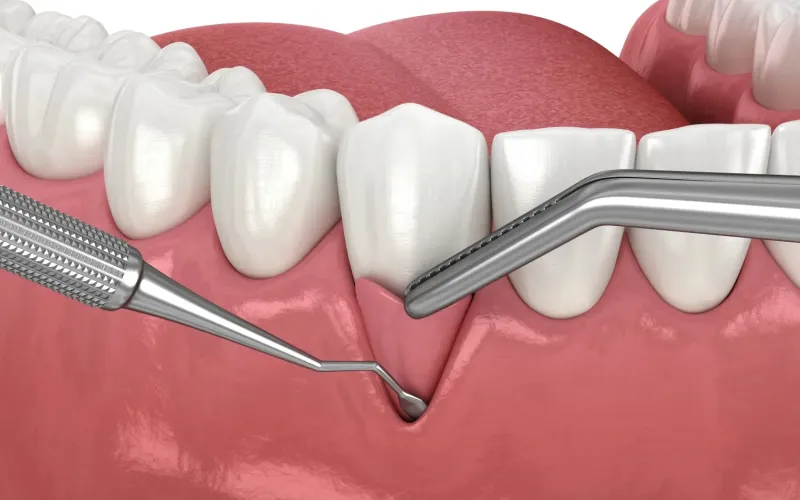
Tobacco is highly harmful to our gums. Its components weaken the gums’ elasticity and their grip on the teeth, gradually leading to tooth loss.
To be more specific, when you smoke, the gums have less blood flow and receive less oxygen, which encourages bacteria to build up. These bacteria cause inflammation in the gums and destroy the tissue that supports our teeth. This inflammation can reach different levels: depending on how severe it is, it is called gingivitis or periodontitis. The latter is more serious, as it affects the deeper periodontal tissues and destroys the bone and ligament that support the teeth.
5. Reduced sense of taste and smell
As we mentioned earlier, tobacco contains very toxic substances, and these have a negative effect on blood circulation. Reduced blood flow means the taste buds receive less blood, which dulls the sense of taste. The same happens with smell: the effect of nicotine reduces this sense. This may be one of the effects least related to the teeth, but it has a big impact on our lives in general.
It is important to remember that there are many other effects, such as slower wound healing, the possibility of developing mouth cancer and many more. So, quitting smoking would be the best solution to the problem.
If you enjoyed this article, we encourage you to click on the following: